University of Houston Athletics
Success Starts With Preparation For Barraza
9/23/2015 12:00:00 AM | Cross Country
The University of Houston Department of Intercollegiate Athletics inspires excellence today while preparing CHAMPIONS FOR LIFE by fostering a culture, which challenges student-athletes to achieve their highest academic, athletic and personal aspirations. Throughout the 2015-16 athletic season, UHCougars.com will highlight Houston student-athletes, coaches and alumni who are committed to building CHAMPIONS FOR LIFE on the field, in the classroom and throughout the community. Today's CHAMPIONS FOR LIFE feature, written by Communications Assistant Armando Reveron, explores the pre-race rituals of Houston Cross Country junior Brian Barraza.
The preparation for a journey to the NCAA Championships all starts on the trip up to a track meet.
Bags are packed, the buses loaded and athletes relax in their seats.
"We are a real tight knit team," Junior Brian Barraza said. "On the way up the race is on the backburner. The trip is just another cool trip with the guys.
Growing up in El Paso, Texas, Barraza was so hyper that his mom signed him up for track and field to release all his bottled up energy.
For Barraza running comes naturally.
"I started off as a sprinter doing 100-meter races and relays," Barraza said. "Eventually as I started getting older everyone started getting faster, and I wanted to move up to longer and longer distances."
The 2014 American Conference Indoor Champion in the Men's DMR was not highly sought after in high school. In fact, it wasn't until University of Houston head cross country coach Steve Magness took a recruiting visit to his high school seeking a commitment from a girl â€" she turned down his offer â€" that he was finally noticed. Since then Barraza has pushed himself mile after mile, reaching new milestones and breaking old ones along the way.
He credits Magness as the reason for him being at the University because Magness was the only coach that showed interest in him.
"Knowing that I have somebody that is so knowledgeable about everything that goes into running, somebody that believes what I believe and somebody who will do anything for me and I will do anything for them helps my preparation greatly," Barraza said. "He knows what it takes. He has seen people go to world championships and has produced talent, and he can make anybody fast."
But for the University of Houston track team, there is a certain expectation of greatness because of the type of athletes the program has produced throughout its history.
The University of Houston is situated in a conference that has competitors of the highest caliber. In order to compete against some of the fastest athletes in the world, one must be prepared in the best way possible.
"We try and gear ourselves towards the championship season," Barraza said. " Five years from now, nobody is going to ask who won the Rice Invitational; they're going to ask if we remember UH crushing their competition in conference."
Upon arrival to their meet, the team reminds each other that it is game time and it's time to get to work. Once shakeout runs and warm-ups are done, it's finally time to run.
"Warming up is pretty nerve-racking," Barraza said. "During warm-ups, you are looking around and wondering if that guy is fast because you've heard things about that guy. You get anxious and by the time you get to the line you just wish they would fire the gun."
As he heads to the line Barraza puts on his signature red Houston headband.
Out of habit, he started wearing headbands in high school because his hair was so long. He thought he'd carry the tradition over from high school, so he went to the bookstore seeking a bigger, thicker sweatband with Houston written on it.
"I haven't run a race in college without it," Barraza said.
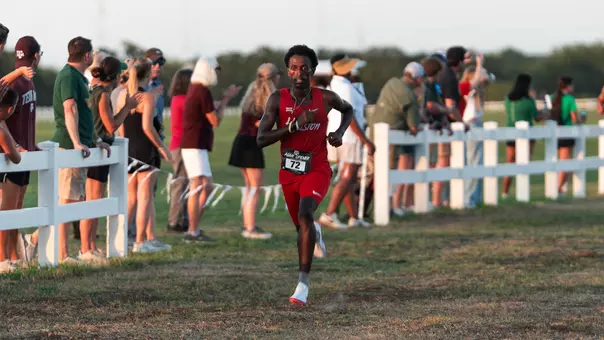
When the gun goes off and the runners dash off, there's only one thing to do now - finish.
In the first mile Barraza does a systems check to make sure everything is in good working order. The work begins as miles two and three approach. Barraza checks his positioning, looks for his teammates and sees where he is in relation to the leader.
As the runners hit their stride and come up on miles four and five, six if you are running a 10k, they will begin to notice the pain.
"You just say to yourself this 'hurts, really bad'." Barraza said. "We mostly focus on the pain and say that it is going to continue to hurt until we cross the line."
From intense workouts to proper rest, track athletes have to stay in peak form for their races.
"Most of the time when we are doing racing we are training through (the race) because we don't care about each individual race; we are looking at conference, regionals and nationals," Barraza said.
Barraza is no stranger to the expectations that come with being a UH track athlete. He knows that having coaches like Leroy Burrell and Carl Lewis is a blessing, and being able to see all their accomplishments and learn from them is a track athlete's dream.
Having coaches who have been there and done that gives Barraza a calm mind about running a race. Knowing that Magness has coached athletes that have gone on to run world championships eases and excites him. After all, Magness coached Barraza to a fourth-place finish at the 2014 NCAA South Central Regional, and a berth in the NCAA Championships, marking the first time a UH athlete had been to an NCAA Championship since 2011.
When coming up to the last 800 to 400 meters is when you can say "I'm almost there." It is the time to pick up whatever you have left in the tank and try to pass as many people as you can. And if you are leading, not letting anyone pass you.
According to Barraza, crossing the finish line is a great feeling. Whether you earned a top spot or not, knowing that you completed the race and made it through in one piece alleviates your stress.
"It is amazing. You have this ridiculous burden of work that you just did, your legs are feeling like garbage and you're maxed out aerobically, and then you cross the line and you let out this big sigh of relief." Barraza said.
Even when facing the best athletes in the world there is one thing Brian has learned:
"You can run with anyone, you really can. It doesn't matter where you think you're at, because you can go toe-to-toe with anybody."