


University of Houston Athletics
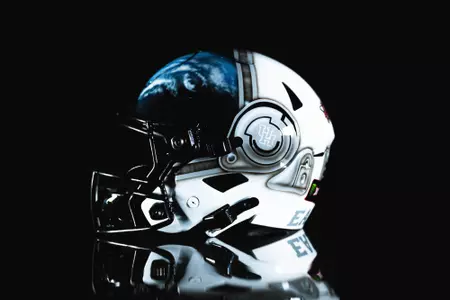
Built By Houston: Gridiron Galaxy
10/2/2026 7:30:00 PM | Football
Cougars debut 10 unique hand-painted helmets for 2026 Built By Houston game
Every year, football fans across the country itch for the next awe-inspiring highlight, hype video, game promo, fan-centric event and uniform. Houston's plan is to lead the conversation for each of those with its annual Built By Houston Game.
The Built By Houston game will be an annual celebration of what makes Houston what it is, the food, the Rodeo, the music and hip-hop legacy, the world's leader in space exploration, architecture and engineering, the city's sports culture, the iconic Houston Blue street tiles and police vehicles, the energy industry, and so much more. Each year brings a new theme, giving the department and football team a fresh way to honor the city that built them.
In 2026, that tradition took its next step with the debut of one-of-a-kind, hand-painted helmets a signature element of Built By Houston that will evolve every season with a new theme.
This year, that theme is Space. The 2026 Cougars will wear 10 different helmets during its Oct. 3 game against UCF. The 10 helmets represent the each of the eight planets, the Sun and famous dwarf planet Pluto.
Sun. Mercury. Venus. Earth. Mars. Jupiter. Saturn. Uranus. Neptune. Pluto.
Each helmet also has a connection to Houston or the University, which ultimately means that each helmet has a connection to the Houston Football team and the uniform.
On Saturday, Houston will debut a collection of unique helmet designs inspired by the solar system. The helmets progress from the Sun through Pluto, with each design becoming increasingly rare the farther it travels through the Solar System.

The helmet collection includes:
45 — Sun
23 — Mercury
19 — Venus
15 — Earth
10 — Mars
8 — Jupiter
5 — Saturn
4 — Uranus
3 — Neptune
1 — Pluto
With only one created, Pluto is the rarest helmet in the collection, fitting its place at the farthest edge of the solar system.
The University of Houston has a storied connection to space. In the early days of space exploration, the University established its Clear Lake campus to support NASA's efforts at Johnson Space Center and the second group of NASA Astronauts, which included Neil Armstrong, Jim Lovell and Pete Conrad, was revealed in the Cullen Auditorium on campus. Just as Houston was at the forefront as Warren McVea ('68) became the first scholarship African American football player at a major Texas university in 1965, the first African American astronaut, Guion Bluford, before graduating from Houston in 1987 with an MBA. Bernard Harris, a 1978 graduate of the University of Houston, would also go on to become an Astronaut in 1990.
Earlier this year, one of 15 international universities in the Axiom Space University Alliance, and the University is a leading institution in Aerospace Engineering, Aerospace Architecture and is at the forefront of aerospace, Earth and planetary sciences. The University has consistently expanded its Space Act Agreement with NASA, allowing significant collaboration and partnerships with both faculty and students.
 CELESTIAL BREAKDOWN
The Sun: Houston has always been a city powered by energy. The Sun represents the energy force at the center of our solar system. Houston is a force at the forefront of the energy industry. Need we say more?
Mercury: The fastest planet around the Sun represents momentum. Houston's story has always been about movement – building, growing and pushing toward whatever comes next. However, NASA's Mercury program preceded the establishment of Houston's Manned Spacecraft Center. Houston then became the center of American human spaceflight as NASA progressed into Gemini and Apollo.
Venus: Venus is wrapped in an incredibly dense atmosphere. What we see from afar hides the actual world underneath. Hidden beneath its clouds is a world unlike what appears from a distance. Houston is the same. Look beyond the skyline and you'll discover the people, cultures and ideas that make this city unlike anywhere else.
Earth: Home. Astronauts, who base out of Houston, leave Earth from different launch sites, but American human spaceflight has been guided from Houston for generations. Mission Control at the Johnson Space Center has served as the operational hub of American human spaceflight since Gemini IV.
Mars: Houston students and professors helped guide humanity to the moon and now UH professors and students are helping send man to Mars. Houston's Space Architecture program has worked on concepts involving Mars transportation and habitation. More recently, UH's NASA-funded IDEAS² center has been developing deployable systems and infrastructure intended to support long-term human presence on the Moon and Mars.

Jupiter: Houston is the largest city in the US in land size. Jupiter is the largest planet in our solar system. Not only is Houston large in scale, but it is also large in ambition, exploration, business, science, engineering, and medicine. Jupiter and Houston are more than just "everything is bigger here."
Saturn: Saturn is a planetary beauty and is instantly recognizable by its rings. The University of Houston Sasakawa International Center for Space Architecture was founded in 1987 and operates the world's only Masters program in Space Architecture. Its mission involves designing environments in which humans could live and work beyond Earth. Everyone knows engineering is art. Art is beauty.
Uranus: Uranus is built different. Just like Houston doesn't fit nicely into one category, culture, or subset of communities. To be Built By Houston means something, just like Uranus which is tilted 98 degrees on its side – Uranus and Houston do things differently.
Neptune: The planet with the fastest winds and the craziest weather, Houston and Neptune have a lot in common when it comes to enduring storms. Storms shape Neptune's landscape, as storms have shaped Houston. The Great Galveston Storm propped Houston up as a major city and Houston has weathered storms ever since – Harvey, Allison, Ike, Rita, Carla, and many more. At the end of the day, Houston endures. Houston rebuilds. Houstonians move forward.
Pluto: The planet furthest from Earth, the smallest and most mysterious. Some call it a dwarf, some call it a planet – at the end of the day, there is only one Pluto and there is only one Pluto helmet. The rarest of them all.

Built By Houston is not a fundraising campaign or a marketing plan. It is a rallying cry to Houstonians and Cougar faithful. It represents everything it means to be a Cougar or from the City of Houston.
Our student-athletes, coaches, staff, fans, supporters and alumni are Built By Houston. The future is Built By Houston. As Houston competes in the Big 12 and continues investing in championship-level programs, facilities and the student-athlete experience, the message is both a celebration of where Houston Athletics comes from and a statement about where it is going.
The Built By Houston game will be an annual celebration of what makes Houston what it is, the food, the Rodeo, the music and hip-hop legacy, the world's leader in space exploration, architecture and engineering, the city's sports culture, the iconic Houston Blue street tiles and police vehicles, the energy industry, and so much more. Each year brings a new theme, giving the department and football team a fresh way to honor the city that built them.
In 2026, that tradition took its next step with the debut of one-of-a-kind, hand-painted helmets a signature element of Built By Houston that will evolve every season with a new theme.
This year, that theme is Space. The 2026 Cougars will wear 10 different helmets during its Oct. 3 game against UCF. The 10 helmets represent the each of the eight planets, the Sun and famous dwarf planet Pluto.
Sun. Mercury. Venus. Earth. Mars. Jupiter. Saturn. Uranus. Neptune. Pluto.
Each helmet also has a connection to Houston or the University, which ultimately means that each helmet has a connection to the Houston Football team and the uniform.
On Saturday, Houston will debut a collection of unique helmet designs inspired by the solar system. The helmets progress from the Sun through Pluto, with each design becoming increasingly rare the farther it travels through the Solar System.
The helmet collection includes:
45 — Sun
23 — Mercury
19 — Venus
15 — Earth
10 — Mars
8 — Jupiter
5 — Saturn
4 — Uranus
3 — Neptune
1 — Pluto
With only one created, Pluto is the rarest helmet in the collection, fitting its place at the farthest edge of the solar system.
The University of Houston has a storied connection to space. In the early days of space exploration, the University established its Clear Lake campus to support NASA's efforts at Johnson Space Center and the second group of NASA Astronauts, which included Neil Armstrong, Jim Lovell and Pete Conrad, was revealed in the Cullen Auditorium on campus. Just as Houston was at the forefront as Warren McVea ('68) became the first scholarship African American football player at a major Texas university in 1965, the first African American astronaut, Guion Bluford, before graduating from Houston in 1987 with an MBA. Bernard Harris, a 1978 graduate of the University of Houston, would also go on to become an Astronaut in 1990.
Earlier this year, one of 15 international universities in the Axiom Space University Alliance, and the University is a leading institution in Aerospace Engineering, Aerospace Architecture and is at the forefront of aerospace, Earth and planetary sciences. The University has consistently expanded its Space Act Agreement with NASA, allowing significant collaboration and partnerships with both faculty and students.
The Sun: Houston has always been a city powered by energy. The Sun represents the energy force at the center of our solar system. Houston is a force at the forefront of the energy industry. Need we say more?
Mercury: The fastest planet around the Sun represents momentum. Houston's story has always been about movement – building, growing and pushing toward whatever comes next. However, NASA's Mercury program preceded the establishment of Houston's Manned Spacecraft Center. Houston then became the center of American human spaceflight as NASA progressed into Gemini and Apollo.
Venus: Venus is wrapped in an incredibly dense atmosphere. What we see from afar hides the actual world underneath. Hidden beneath its clouds is a world unlike what appears from a distance. Houston is the same. Look beyond the skyline and you'll discover the people, cultures and ideas that make this city unlike anywhere else.
Earth: Home. Astronauts, who base out of Houston, leave Earth from different launch sites, but American human spaceflight has been guided from Houston for generations. Mission Control at the Johnson Space Center has served as the operational hub of American human spaceflight since Gemini IV.
Mars: Houston students and professors helped guide humanity to the moon and now UH professors and students are helping send man to Mars. Houston's Space Architecture program has worked on concepts involving Mars transportation and habitation. More recently, UH's NASA-funded IDEAS² center has been developing deployable systems and infrastructure intended to support long-term human presence on the Moon and Mars.
Jupiter: Houston is the largest city in the US in land size. Jupiter is the largest planet in our solar system. Not only is Houston large in scale, but it is also large in ambition, exploration, business, science, engineering, and medicine. Jupiter and Houston are more than just "everything is bigger here."
Saturn: Saturn is a planetary beauty and is instantly recognizable by its rings. The University of Houston Sasakawa International Center for Space Architecture was founded in 1987 and operates the world's only Masters program in Space Architecture. Its mission involves designing environments in which humans could live and work beyond Earth. Everyone knows engineering is art. Art is beauty.
Uranus: Uranus is built different. Just like Houston doesn't fit nicely into one category, culture, or subset of communities. To be Built By Houston means something, just like Uranus which is tilted 98 degrees on its side – Uranus and Houston do things differently.
Neptune: The planet with the fastest winds and the craziest weather, Houston and Neptune have a lot in common when it comes to enduring storms. Storms shape Neptune's landscape, as storms have shaped Houston. The Great Galveston Storm propped Houston up as a major city and Houston has weathered storms ever since – Harvey, Allison, Ike, Rita, Carla, and many more. At the end of the day, Houston endures. Houston rebuilds. Houstonians move forward.
Pluto: The planet furthest from Earth, the smallest and most mysterious. Some call it a dwarf, some call it a planet – at the end of the day, there is only one Pluto and there is only one Pluto helmet. The rarest of them all.
Built By Houston is not a fundraising campaign or a marketing plan. It is a rallying cry to Houstonians and Cougar faithful. It represents everything it means to be a Cougar or from the City of Houston.
Our student-athletes, coaches, staff, fans, supporters and alumni are Built By Houston. The future is Built By Houston. As Houston competes in the Big 12 and continues investing in championship-level programs, facilities and the student-athlete experience, the message is both a celebration of where Houston Athletics comes from and a statement about where it is going.


Saturday, September 26
Monday, September 21
Sunday, September 20
Saturday, September 12